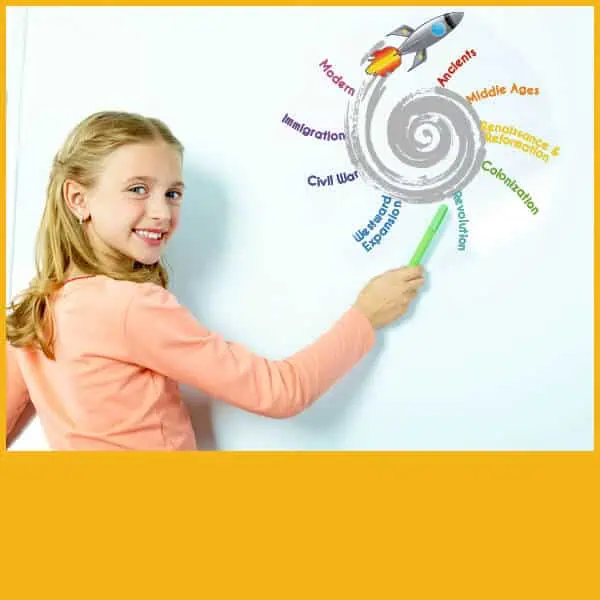
Like most literature-based curricula, we study history chronologically, beginning with Creation. But our History Cycle is a little different.
Most history cycles rotate through history every four years. I initially tried that history cycle with our kids, too. Unfortunately, by the time the Ancient period rolled around again four years later, my younger kids didn’t remember a thing!
So we follow a different history rotation with our curriculum. In fact, we repeat the history cycle each year.
After a year, even your younger children will recall that the Middle Ages were the time of kings, knights, and castles. The next year, they’ll connect new information to the old information. Which is the way we learn, according to science research.
Each year you can study different aspects of each historical period: One year, focus on the daily life or the prominent people. Another year, the battles or the technological and scientific achievements. It’s your choice!
Year builds upon year, layer by layer.

You go deeper and deeper into each period – you just do it over the years instead of studying one period at a time for a year.
Even better, the lively pace of moving to fresh material more quickly keeps students engaged. And helps them (and you) better understand the flow of history.
Rather than learning about history in isolated events, they’ll discover how events and people in one part of the world affected another.
For example, they’ll learn that the Black Death that started in Asia helped pave the way for Europe’s renaissance.
All of our curricula is literature-based and written from a biblical worldview.